Perpetual licence, one payment
Take back control of your SMS
Turn any Android phone into a private SMS gateway, a conversational bot and a bulk sending platform, fully self-hosted. Pay once, plug in your own SIM cards, and send without a subscription or a per-message fee.
No message, no contact and no log ever passes through our servers.
What changes compared with a cloud service
Your data stays with you
The gateway runs on your own machine, with its own local database. We technically have access to nothing.
A single payment
No subscription, no per-message billing. The marginal cost of a message is whatever your carrier plan charges.
Unlimited volume
We impose no quota. The only limit is your SIM cards and your carrier.
Keeps running without us
Your licence is yours from the moment you buy it. After twelve months, your gateway no longer needs our server at all: it keeps sending even if we disappear. Before that, it rides out any outage of ours of up to 30 days and resumes on its own.
Everything you need, in a single binary
One command to install, a web interface included, a documented API.
Private REST API
Single or bulk sending, idempotency keys, cursor pagination, webhooks signed with HMAC-SHA256.
Conversation workspace
A full two-way inbox in the browser, with search across the whole history.
Auto-responder and rules
Triggers on keyword, regular expression, out-of-hours or first contact, plus webhooks to n8n and Make.
Campaigns and contacts
Groups, tags, CSV import with de-duplication, scheduling and live progress tracking.
Short links and click tracking
A built-in shortener that counts clicks, with no dependency on an outside service.
Several devices, several SIMs
Automatic load balancing across your phones and SIM cards, with a per-SIM quota.
What you actually get
Screens of a working gateway, not drawings. The figures are those of a demonstration installation.
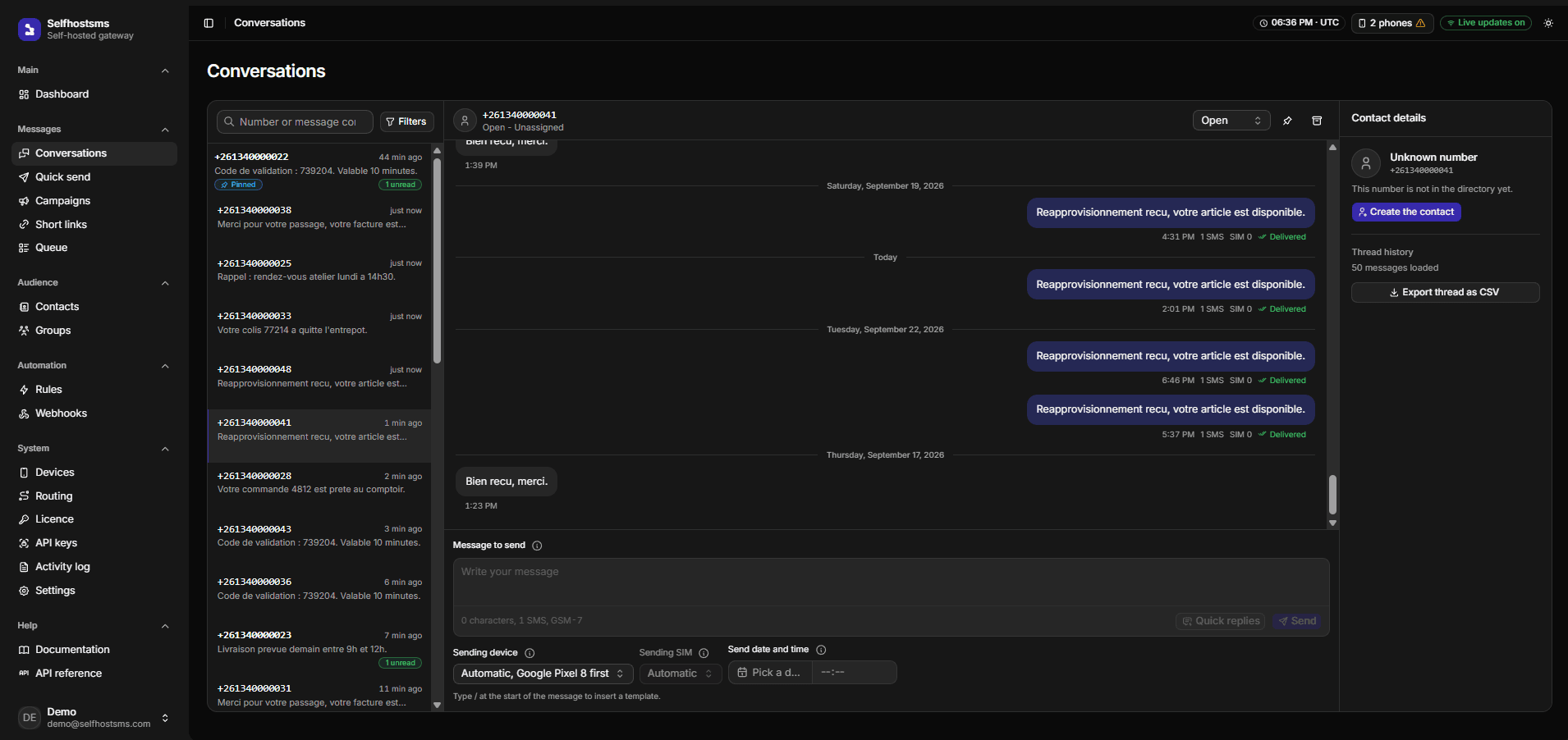
A real inbox
Every SMS your phones receive lands in a thread. Reply, sort, assign, label, and the answer leaves from the number your correspondent already knows.
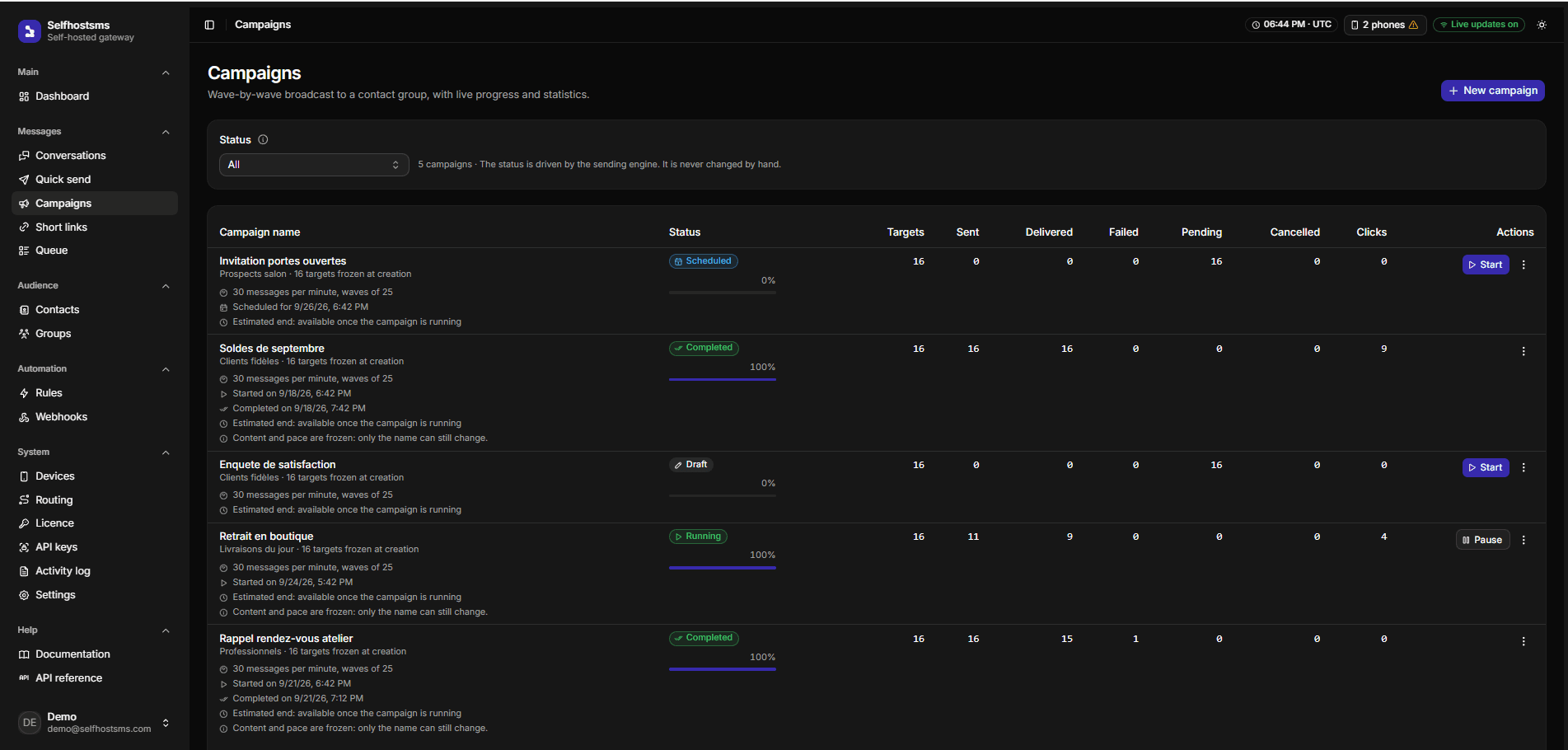
Campaigns, wave by wave
Broadcast to a contact group at a pace you choose, and follow every state: scheduled, running, completed, with delivered, failed and clicks.
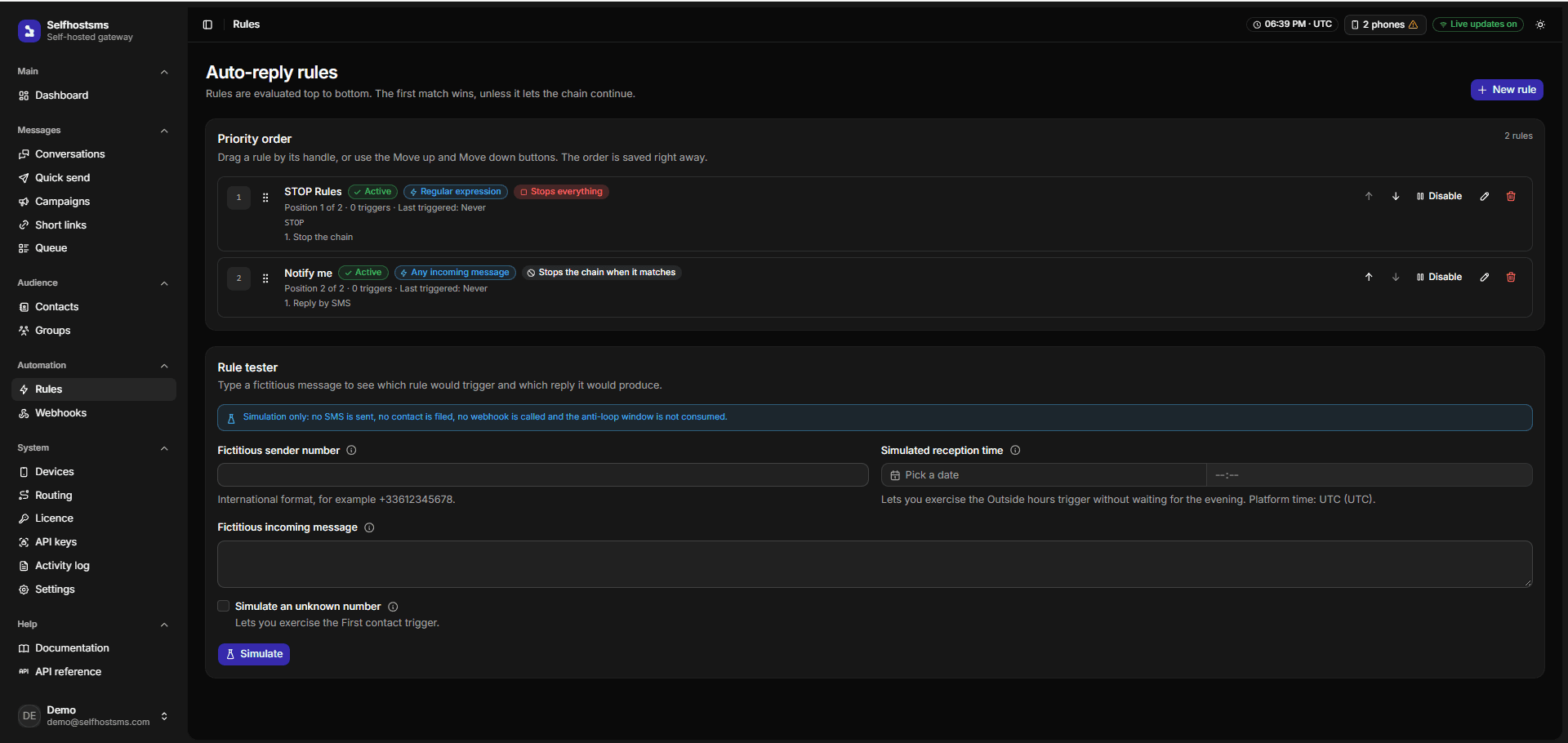
Automation without code
A trigger, conditions, actions. Reply on a keyword, tag a thread, file a contact, call a webhook, all from the dashboard.
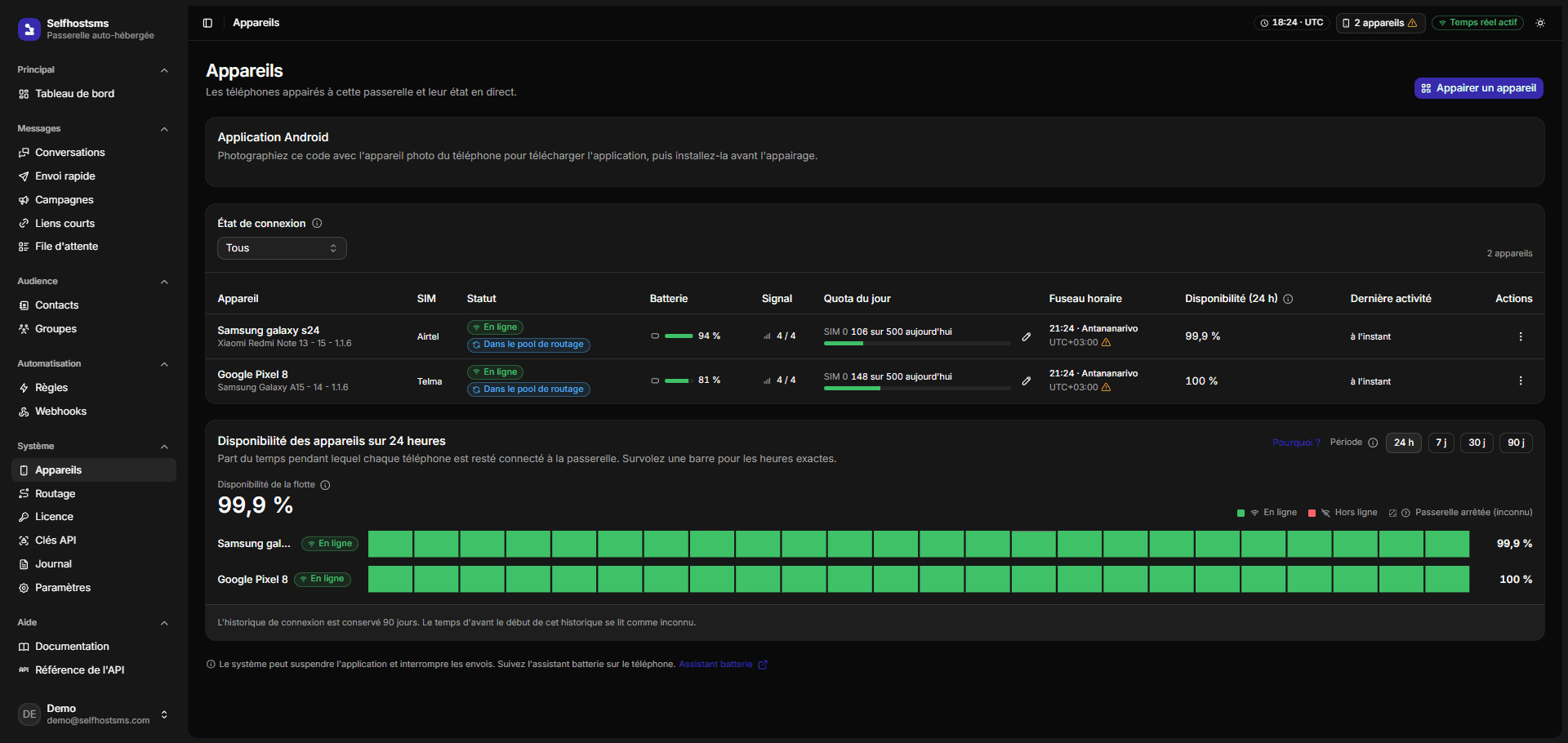
Your phones, watched
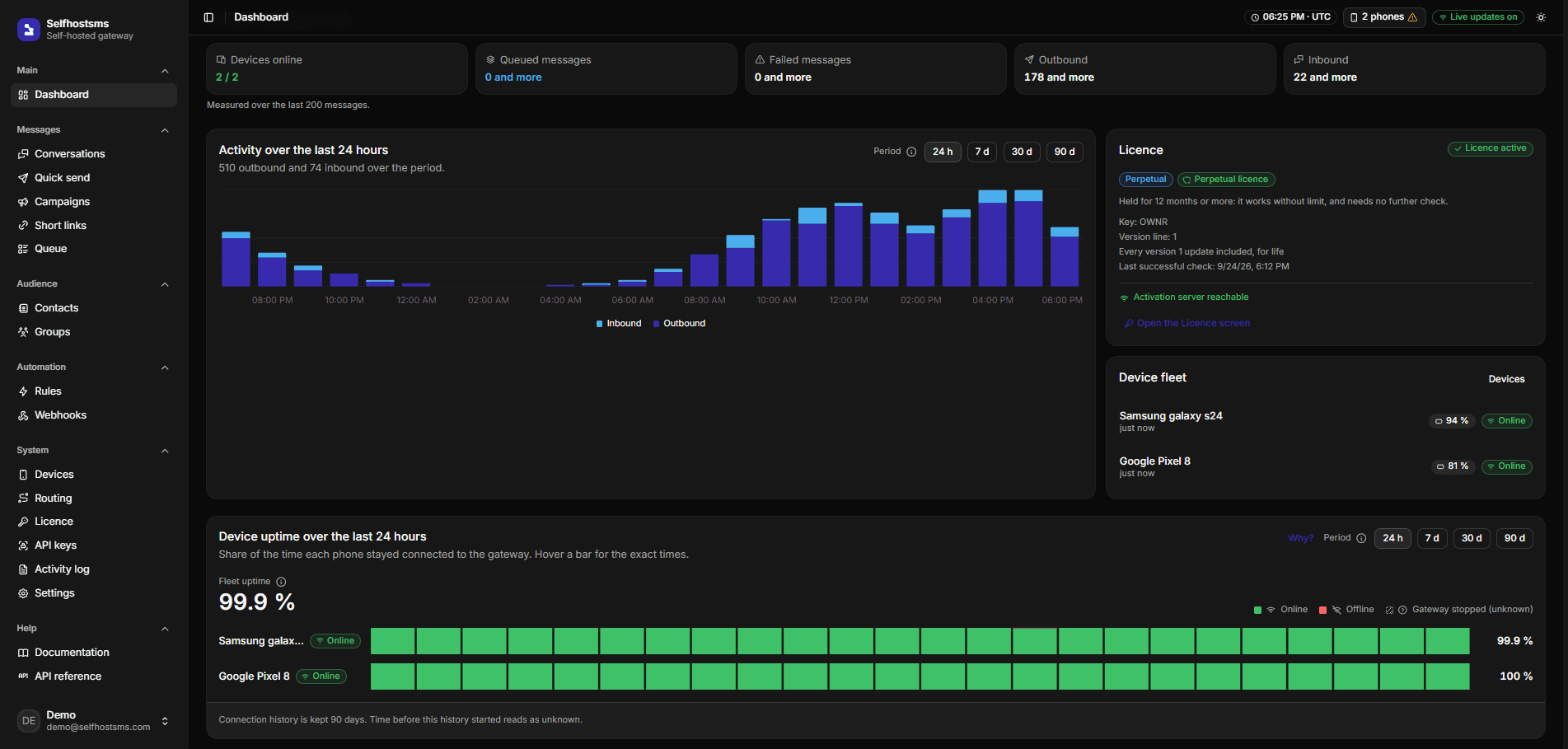
Battery, signal, daily quota per SIM and connection history hour by hour. A phone that drops is visible before it costs you a message.
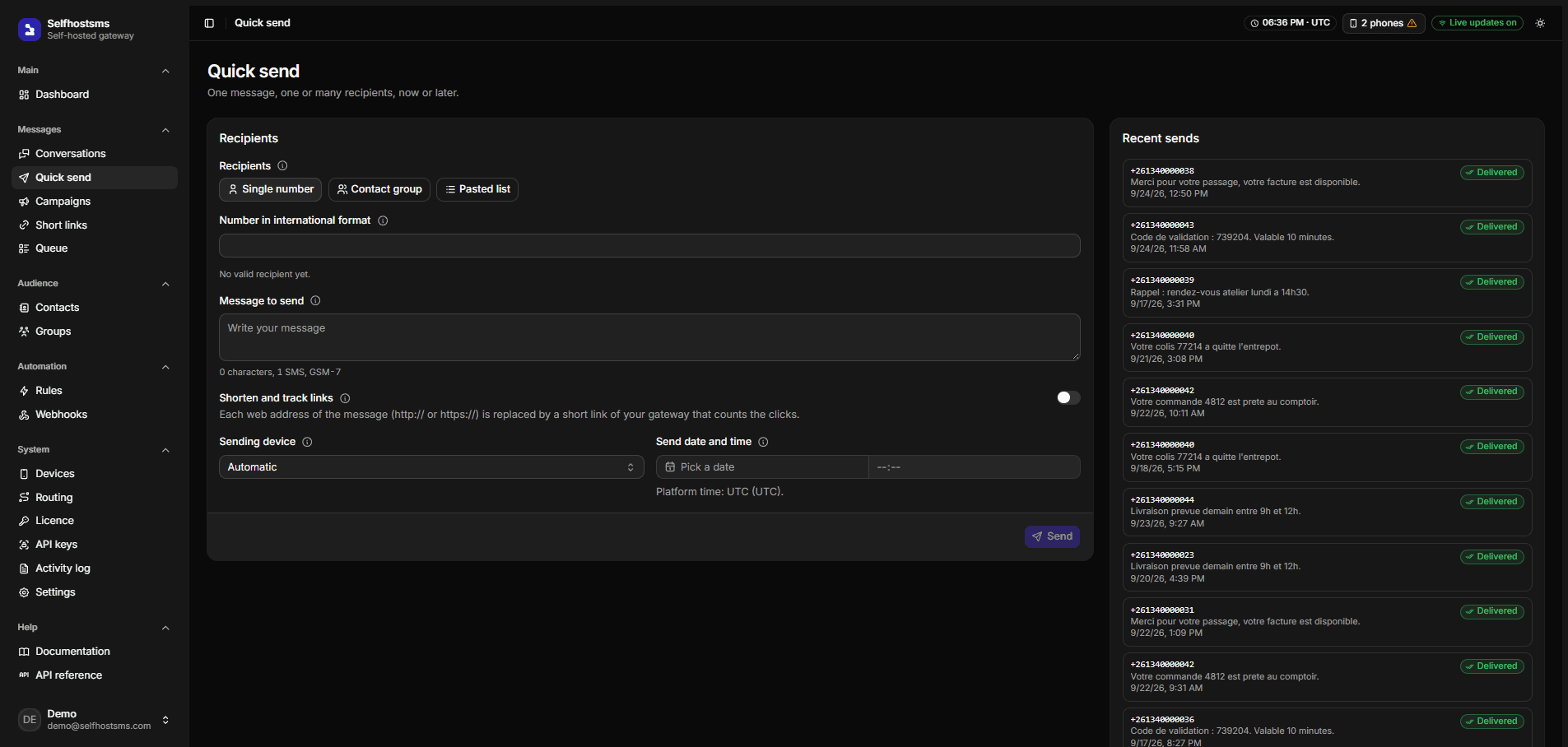
Send in two fields
A number, a text, and it leaves. The same path the API takes, with the same routing rules and the same quotas.
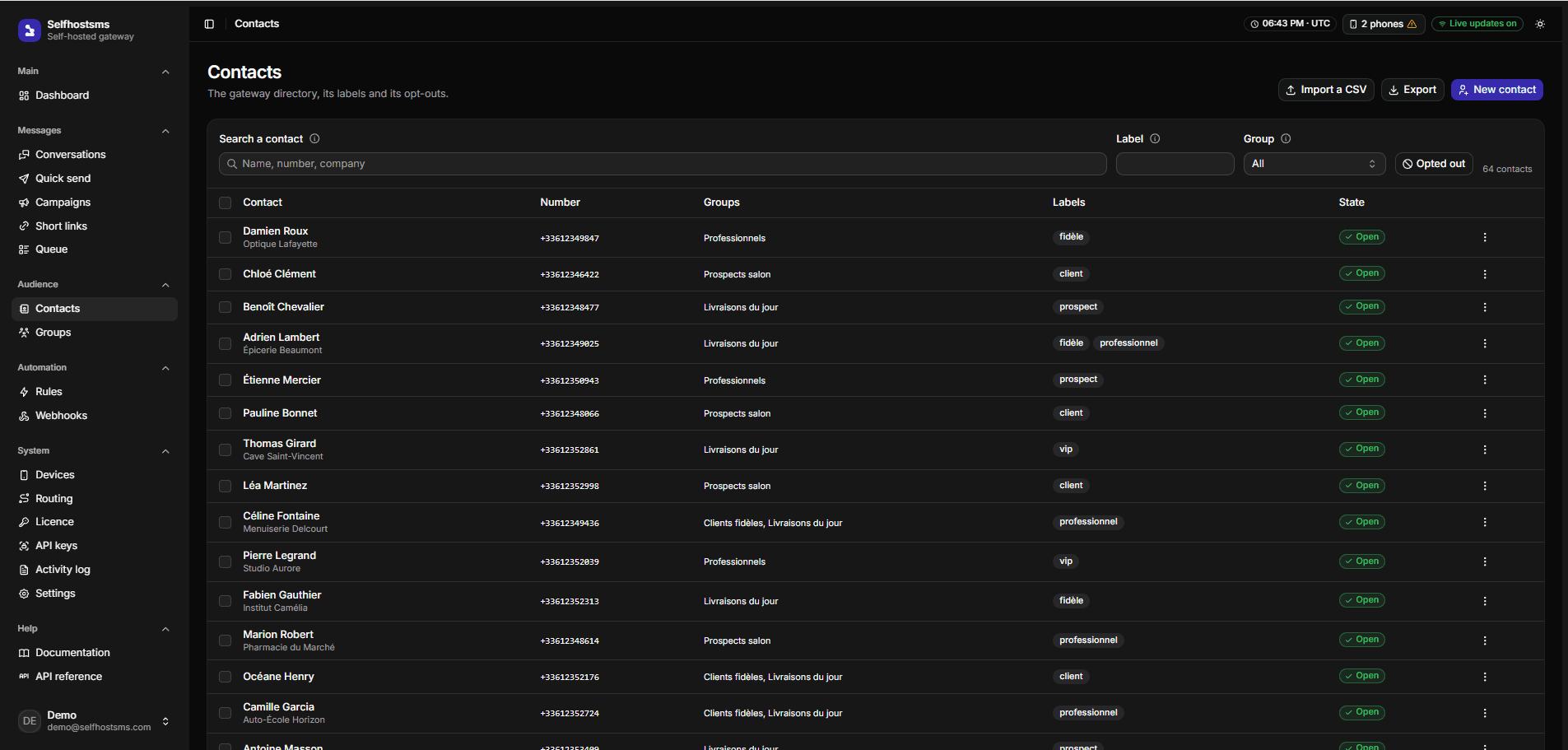
Your directory
Contacts, companies, labels, groups, full-text search and CSV import. It is your list, on your machine, exportable whenever you want.
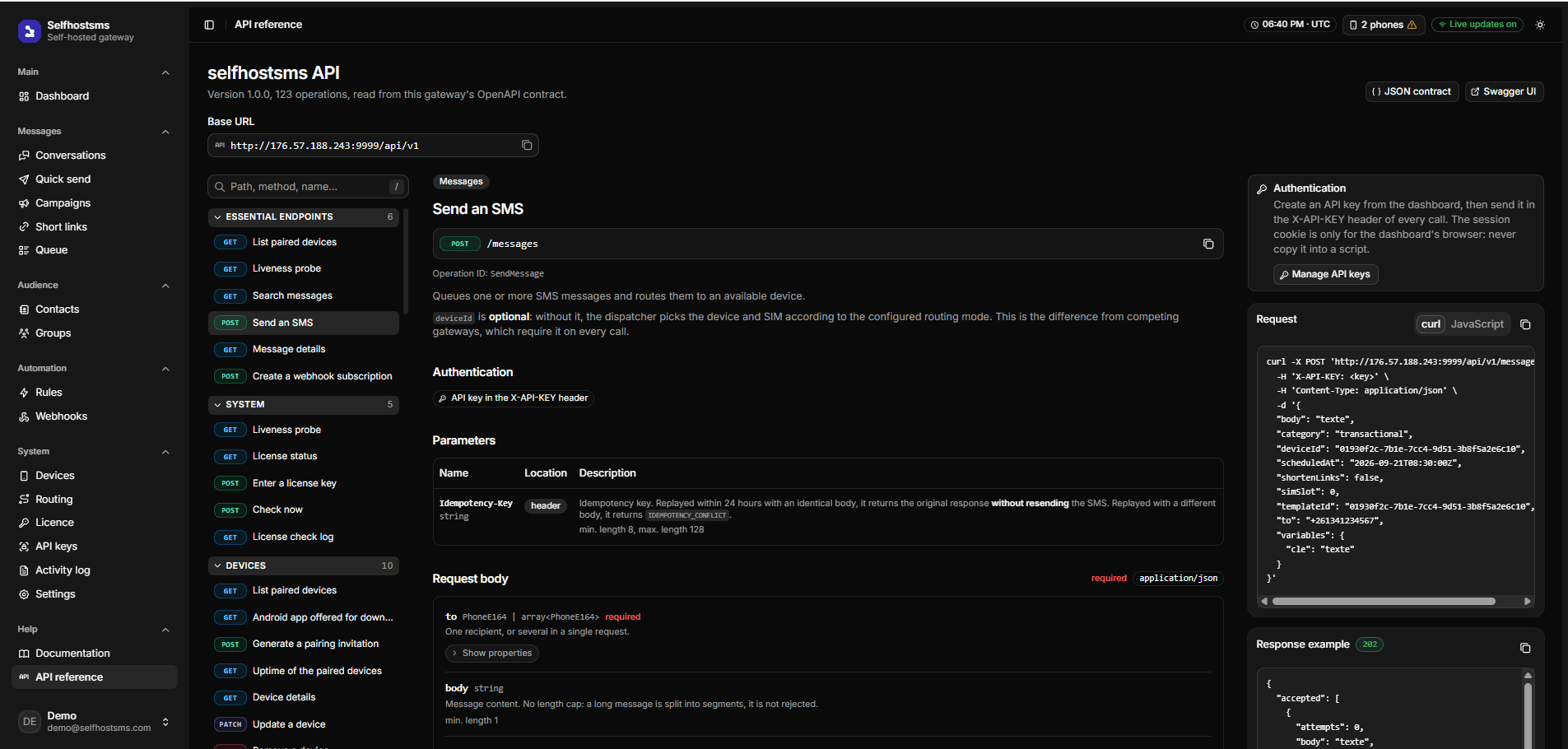
An API you can read
The full reference is served by your own gateway, with ready-to-copy examples. No key leaves your installation to read it.
Three steps, fifteen minutes
Install the gateway
One command on your server, your desktop machine or a free-for-life cloud instance. The binary carries everything.
Pair a phone
Scan the signed QR code from the Android app. No address and no token to retype.
Send your first message
Copy the example pre-filled with your real API key. The first call works on the first try.
At a glance
The six differences that weigh most on the bill and on the risk.
| Criterion | Twilio and brokers | SimGate | SMS Flow | Our solutionOur column |
|---|---|---|---|---|
| Pricing model | Pay as you go, forever | Monthly subscription | Per message sent and received | One payment, for life |
| Where your data lives | The vendor's servers | Relayed through their cloud | Stored in their cloud | Your machine, local database |
| Conversation interface | No, API only | Basic | History table | Two-way inbox |
| Message length | Automatic splitting | Automatic splitting | Capped at 500 characters | Unlimited, with segment counter |
| Multi-device balancing | Not applicable | Yes | No, device is mandatory | Yes, with per-SIM quotas |
| If the vendor disappears | Service stops | Service stops | Service stops | Keeps running for good after 12 months |
Work out what you pay today
Enter your real volume: the table compares the cumulative cost at market providers with the single payment for the licence.
Cumulative cost over 24 months
| Provider | Per month | Total for the period |
|---|---|---|
| Twilio | €500.00 | €12,000.00 |
| SMS Flow | €53.00 | €1,272.00 |
| SimGate | €19.00 | €456.00 |
| Our solutionLicence paid once | €0.00 | €69.00 |
You save €11,931.00 over the period against the most expensive offer.
The licence pays for itself in the first month against Twilio.
Calculation assumptions
Public rates observed at each provider and converted into the selected currency. A flat monthly subscription is assumed for SimGate, since no public per-volume grid exists.
Indicative estimate. The real cost of a message sent from the gateway remains whatever your carrier plan charges.
Stop paying for your messages one by one
One licence, one binary, your own SIM cards. The rest belongs to you.