Your phones already send SMS. What exactly are you renting?
The route already exists
Take the phone on your desk and send a message to a customer. It arrives. No API key, no per-message price, no account to keep in good standing. Your carrier carried it, on a plan you already pay, often out of a bundle you never finish.
Now send the same message through a cloud SMS provider. It also arrives, and you are billed. Somewhere between the two, a company inserted itself into a path that already went from your SIM card to your customer's phone.
Sometimes that insertion earns its keep. If you write to forty countries, or need a short code, or send a hundred thousand messages an hour, a provider does real work you would not want to redo. But a great many businesses do none of those things. They send order confirmations, appointment reminders, one-time codes and delivery notices, inside one country, to numbers their own carrier serves every day.
What a gateway actually is
A self-hosted SMS gateway is a small program that sits between your software and a phone you own. Your application calls it over HTTP exactly as it would call a cloud API. It picks one of your phones, hands it the message, and that phone sends it the way it would send any other SMS.
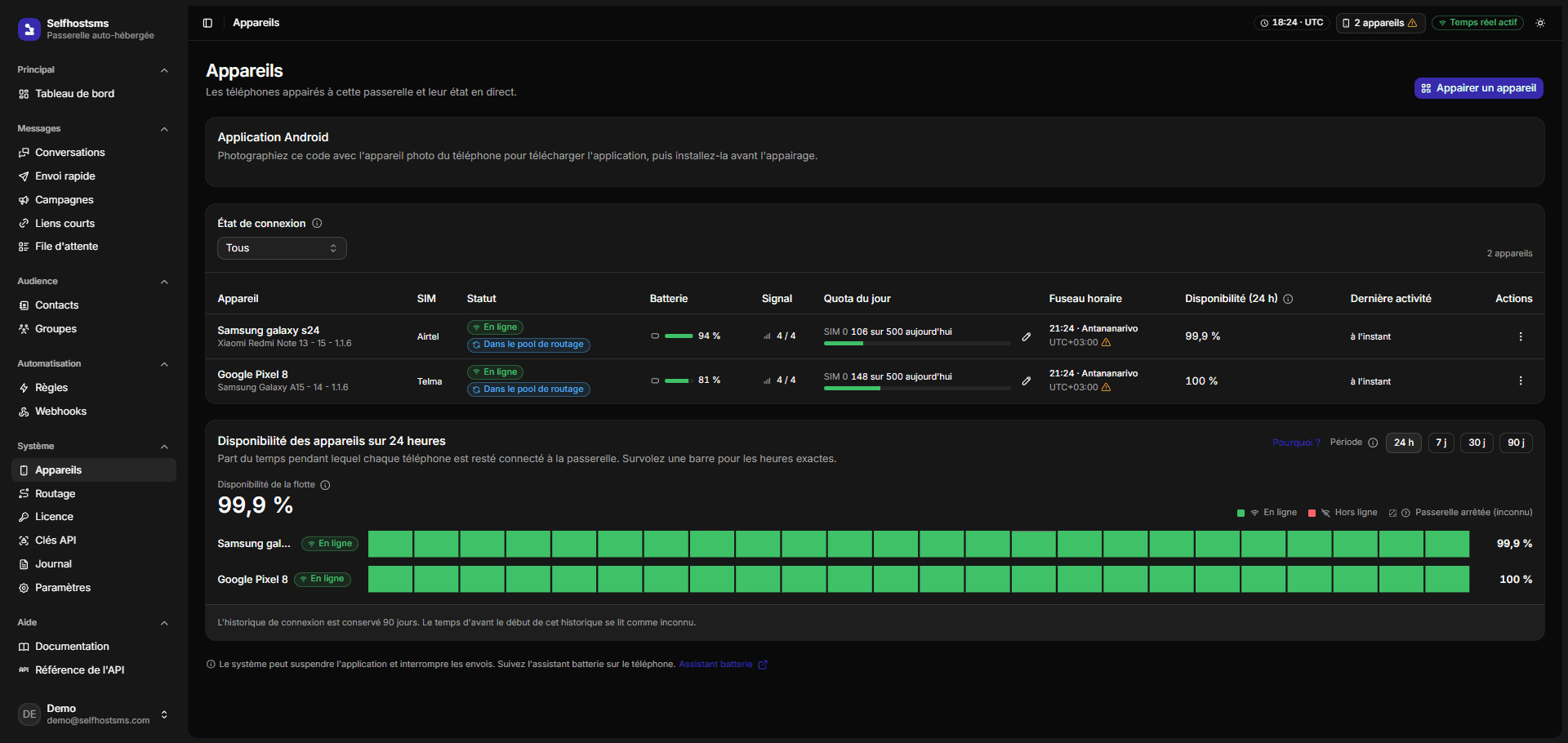
Nothing exotic happens. The phone is not rooted, it is not the default messaging app, it does not run a modified Android. It runs one application that holds a connection to your gateway and sends what it is told to send.
What changes, and what does not
What does not change: your integration. You still make an HTTP call with a number and a text, you still get an identifier back, you still follow the status. If your code speaks to an SMS API today, it will speak to this one tomorrow.
What changes:
- The marginal cost of a message becomes whatever your carrier charges you, which is usually nothing until the bundle runs out.
- The messages stop passing through anyone else. Your application talks to your gateway, your gateway talks to your phone, your phone talks to your carrier. There is no fourth party, because there is no network path for one.
- You own the history. Conversations, contacts and logs sit in a database file on your machine, which you can copy, move or delete.
The honest limits
Three things a cloud provider does that a phone in your office does not.
Throughput. One SIM card sends a few messages per minute before a carrier starts treating it as spam. Adding phones and SIM cards raises the ceiling, and the gateway spreads the load across them, but it is a ceiling in the hundreds per hour, not the hundreds of thousands.
Reach. Writing to a country your carrier does not serve well means paying roaming rates or not arriving at all. A provider with dozens of routes will do better.
Uptime is yours now. A phone that runs out of battery or loses Wi-Fi stops sending, and nobody is paid to notice for you. The gateway watches them and warns you, but the phone is on your desk, not in a data centre.
If those three limits do not describe your traffic, then the route you are renting is one you already own.